

Make / Model Search
New models - Isuzu - N Series - NQR 88-190Driven: Isuzu’s crucial new N SeriesWe drive the new Isuzu N Series to see if the first big update in 17 years delivers1 Dec 2025 ISUZU has held the number one spot on the Australian light truck sales ladder for 36 consecutive years, but the arrival of the MY25 N Series marks the first all-new model range since 2008.
There is a lot at stake, heightened by the fact these models are based on an entirely new platform as Isuzu Australia Limited nears the completion of its comprehensive and range-wide product renewal program.
As GoAuto suspected after an initial drive of an NLR 45-150 with a car-licence suitable 4500kg GVM in April, and confirmed during our longer test this month, Isuzu has maintained the soul of its N Series while also improving almost everything from the powertrains to safety, and critically it offers more GVM at the top end of the range.
Like the smaller NLR GoAuto drove in April, the new NQR 88-190 is built on Isuzu’s I-MACS (Isuzu Modular Architecture and Component Standard) platform, which enables the integration of new powertrains and safety systems required to meet the new ADR 80/04 (Euro 6 equivalent) emissions standards.
The NQR 88-190, now with an improved 8800kg GVM (up 100kg on the outgoing NQR), sits at the top of the light-duty tree and bridges the gap between the N Series and the larger F Series, with the example GoAuto drove fitted with a prototype ‘Freightpack’ body from Isuzu’s Ready-To-Work range.
Previously only available on the larger F Series range, the Freightpack has made its way into the N Series line-up, offering an off-the-shelf eight-pallet curtain-side body that is designed to be put straight to work.
Given the growing light-duty freight task, the Freightpack model is likely to be a winner and is a reminder that the truck manufacturers pioneered the concept of aftermarket integration – offering ready-to-go options well before brands like Ford (which recently launched its Pro Converter program).
It means buyers can take advantage of a range of body options, all backed by a three-year manufacturer warranty, at the dealer level without having to deal separately with body builders.
Visually, the new NQR benefits from the same ground-up exterior refresh as the rest of the N Series range, sporting a new three-piece grille, bi-LED headlights with daytime running lamps, but the changes extend well beyond aesthetics.
The N Series now features a dual-lens stereo camera and radar setup, similar to that found on Isuzu’s D-Max ute and MU-X large SUV, offering a suite of 15 active and passive safety features.
Among these are full-speed adaptive cruise control that can be used right down to 0km/h, traffic sign recognition, lane departure warning, and a particularly useful distance warning system that displays the gap to the vehicle ahead in metres on the new digital dash (also lifted from the brand’s ute and SUV).
Inside, the cabin has been overhauled to be more car-like, likely due to the industry’s somewhat dire driver shortage, meaning less experienced operators will be able to drive the new N Series without extensive upskilling required.
Steering wheel diameter has been reduced from 460mm to 440mm and repositioned for a more upright driving position, the seats have been repositioned, and the dashboard has been lowered to improve forward visibility.
Technology is on-par with the passenger car world too, the standard 10.1-inch infotainment touchscreen featuring wired smartphone mirroring and navigation, paired with a 7.0-inch digital instrument display – virtually identical to that which features within D-Max and MU-X models – nestled between the analogue dials.
Now powering the NQR 88-190 is Isuzu’s proven 5.2-litre 4HK1-TCC four-cylinder turbo-diesel engine, producing 140kW at 2600rpm and 513Nm of torque from 1600rpm.
It has gained Euro 6 emisisons compliance courtesy of a selective catalytic reduction (SCR) system that uses AdBlue.
Crucially, while the smaller 3.0-litre N Series models receive a new nine-speed dual-clutch transmission, this higher-torque 5.2-litre variant retains the carryover six-speed automated manual transmission (AMT).
Asked if the nine-speed would find its way behind the larger engine, Isuzu engineers confirmed to GoAuto that it would not, due to the transmission’s maximum torque rating.
However, Isuzu engineers have significantly revised the six-speed AMT’s software for faster, smoother shifting – which could definitely be felt from the driver’s seat.
All N Series models score a six-year/250,000km warranty, plus six years of roadside assist, and Ready-To-Work bodies like the Freightpack are covered for three years.
Servicing will take place every 25,000km or 12 months (whichever comes first), but Isuzu also offers various service agreements for operators wanting a clearer total cost of ownership figure.
On the roadWe took the NQR 88-190 on a two-day drive from Isuzu’s headquarters in Truganina, Victoria, down to Torquay on the south coast, testing it alongside the larger F Series models which share many of the updates.
The most noticeable change off the bat was an improved driving position, with the NQR feeling less bus-like and more like a ute. Unlike a typical ute, the cabover layout and low dash line offer an incredible field of view.
While we were thoroughly impressed by the new nine-speed dual-clutch transmission in the smaller NLR back in April, the revised six-speed automated manual in larger NQR models is noticeably sharper than the previous iteration, which Isuzu told GoAuto is due to improved software.
The 5.2-litre engine feels eager from idle, with peak torque arriving from a lazy 1600rpm.
Even when loaded to around 70 per cent of its maximum GVM, meaning we were running around at roughly seven tonnes, the truck pulled comfortably and without strain.
While Isuzu N Series owners have until now lived without AdBlue, the new model’s emissions-reducing measure is accompanied by improved fuel efficiency. We saw an average of 16L/100km during fairly mixed use, which is quite an incredible figure at these weights.
The active safety offering is a step up over the more basic system rolled out in 2021, and none of the warnings were overly intrusive. The N Series does not get active lane-keep assist, so aside from the AEB the truck is not intervening per se, instead simply offering audible warnings as needed.
Our favourite safety feature is the distance warning system that gives a clear, real-time indication of traffic flow ahead with both distance and speed data, which in a city truck is a nice-to-have feature that we consistently used.
Ride quality is also noticeably better, which is felt over rougher roads and this could come down to the revised steering – both with the smaller wheel and tweaked ratios – but it feels as though the front-end suspension has been tweaked too. This adds to how car-like the N Series now feels.
The NQR 88-190 proves that Isuzu has not just slapped a new face on an old truck, which would have been tempting given how dominant its outgoing range was right up until the point it was pulled.
Instead, Isuzu has redesigned the N Series for the future, while somehow retaining the essence of what makes these trucks so adored by operators. It still drives like an N Series, but a whole lot better again. 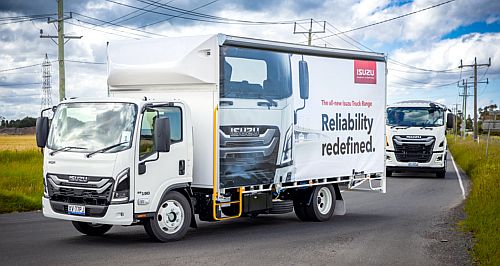 Read more14th of April 2025  Quick Drive: New-generation Isuzu trucksGoAuto gets a sneak peek and brief steer of Isuzu’s new N- and F-Series truck modelsAll new modelsMotor industry news GoAutoNews is Australia’s number one automotive industry journal covering the latest news, future and new model releases, market trends, industry personnel movements, and international events. |
|


 Alfa Romeo
 Abarth
 Audi
Audi Aston Martin
 BMW
BMW Bentley
 Ferrari
 Chevrolet
 Ford
Ford Fiat
Fiat GWM
GWM Foton
Foton Hyundai
 Honda
Honda Jaguar
 Isuzu
Isuzu Kia
Kia Jeep
Jeep Land Rover
 Lamborghini
 Maserati
 Lexus
Lexus McLaren
 Mazda
Mazda MG
MG Mercedes-Benz
 Mitsubishi
 Mini
Mini Peugeot
 Nissan
 Ram
Ram Porsche
 Rolls-Royce
 Smart
Smart Skoda
Skoda Suzuki
 Subaru
 Toyota
 Tesla
Tesla Volvo
Volvo Volkswagen
 Zeekr
Zeekr

Connect with us


Facebook Twitter Instagram